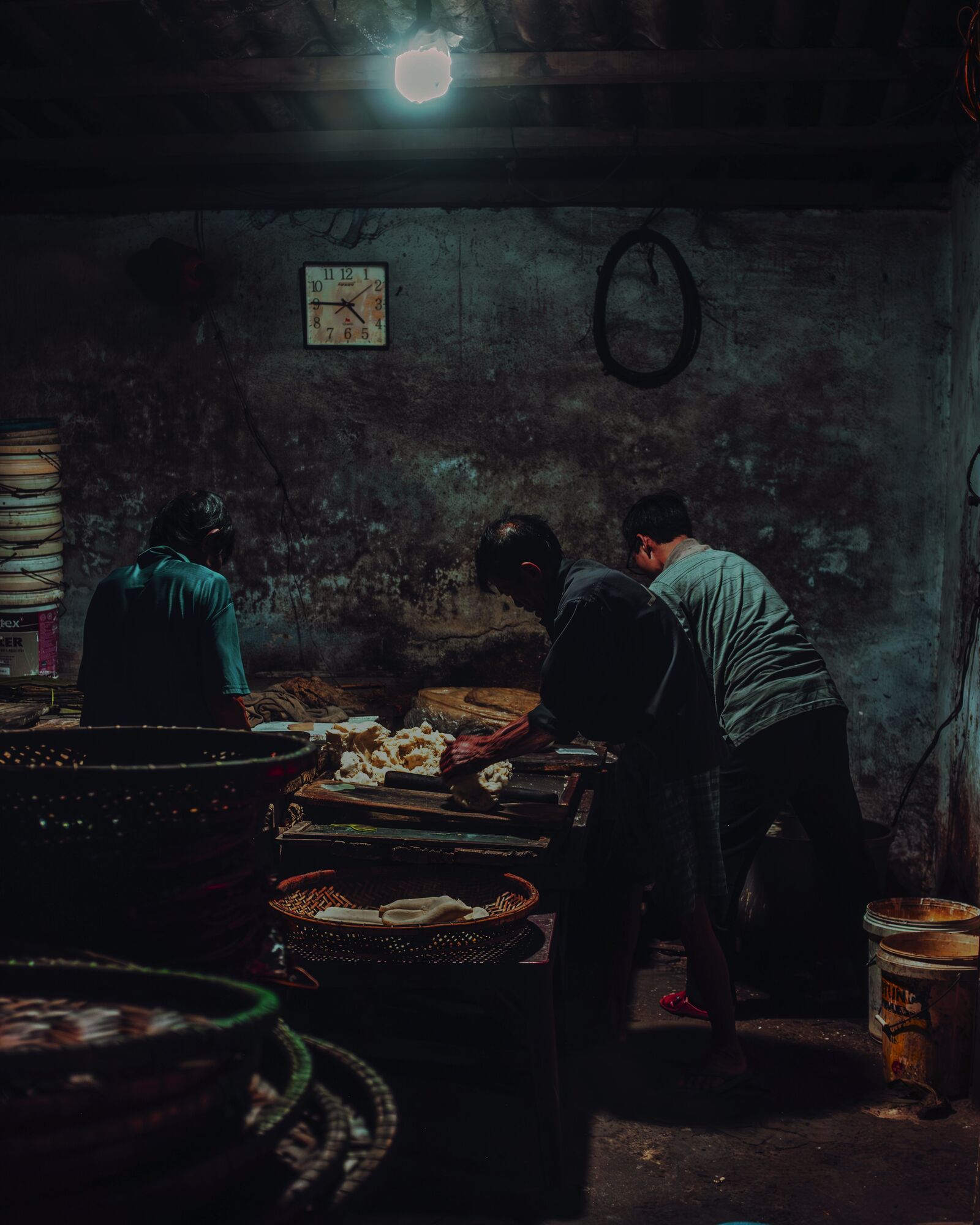
Hội An, 4:45 AM
The last of its kind
Before dawn on the edge of Hội An, two brothers still make cao lầu by hand. What the noodle is, why it only comes from here, and why it may not last.
- Where
- A family noodle workshop in Cẩm Châu, on the edge of Hội An's old town, Quảng Nam, VietnamSince 1 July 2025, Cẩm Châu is part of Hội An Đông ward, in the city of Đà Nẵng. A private home, so the house is not named.
- When
- 4:48 AM, 25 February 2025, in rainAndrew's phone filmed inside the workshop from 4:48 to 4:50 AM, and the camera frame is logged at 4:54 AM local time (its clock was on New York time). The caption says 4:45 AM. Posted 4 March 2025.
- Posted
- 4 March 2025
- View the post
The night has barely given way to morning as we pull on raincoats and ride on the backs of motorcycles. A heavy dew turns to rain, blanketing the sleeping town, but down a dirt path on the edge of the ancient city, one house shines brightly.
In this soot-stained, makeshift noodle factory, smoke clings to the air, mixing with the damp scent of wood and ash water. A man leans over a bubbling vat, carefully folding thick rice paste over itself, an ancient rhythm passed down through generations. His brother does the same in a neighbouring home, each carrying on the labour of tradition, their separate spaces bound by the same purpose.
The scent is unmistakable: rich, earthy, and laced with a faint bitterness from the fire. This is the last of its kind. A craft that once defined a town, now held together by two men. Their children have moved to the city, drawn by modern jobs, air-conditioned offices, a different kind of future. Soon the last batch of handmade cao lầu will be made, and with it a piece of Hội An will quietly disappear.
Its signature texture comes from something deeper: water drawn from Ba Lễ Well, an ancient well in Hội An. The minerals in that water do for these noodles what New York's water does for pizza dough and bagels. The rice is soaked, ground, mixed with the well water and kneaded into dough. It's then thinly sliced and steamed over fire, which gives the noodles their yellow hue and springy bite.
Villages like this were once microcosms of trade, where skills passed from hand to hand, generation to generation. Now people leave, and these traditions fade into the past. Maybe that's just the way of things. Or maybe, in these early morning hours, we're watching something slip away that we don't yet know how to save.
What cao lầu is
Cao lầu is Hội An's own noodle dish, and you rarely find it anywhere else. A bowl is built in layers: fresh greens, bean sprouts and herbs at the bottom, then the noodles, slices of char siu-style pork called xá xíu, and a few squares of the same dough fried until they crunch. Only a little broth goes over the top, just enough to wet the noodles. It comes to the table at room temperature, and you mix everything together before you eat.
The noodles are what make it. They're thick and squarish, amber to yellowish in colour, with a chewy, springy bite.
Why it only comes from here
The story told in Hội An is that real cao lầu needs two things the town can't import. The rice is soaked in lye made by leaching the ashes of certain plants from the Chàm Islands, just off the coast, and the water comes from Bá Lễ, an ancient well in the old town. That, the legend goes, is why you rarely find the dish beyond Hội An.
How strictly anyone follows that today is less clear. In 2023, Saigoneer wrote that it's unclear whether those hyper-local ingredients are still required. A 2025 account of another family workshop describes dough made with water from local wells and the ash of Melaleuca cajuputi, the cajuput tree.
What the ash does is plain chemistry. Soaking rice in lye water gives the strands their chewy spring and their grey-brown to yellow colour, and the alkaline water helps the noodles keep for longer.
How it's made
It's night work. In the workshop described in 2025, four family members start at 11 PM, while the city sleeps. The rice is soaked, then ground into a paste. The paste is boiled with nước tro, the ash water, and pounded into dough. Slabs of dough are steamed over a wood fire, cooled, kneaded, rolled out by hand and cut into noodles, then laid on bamboo baskets lined with banana leaf for a second steaming.
That's what 4:45 AM looks like here: a vat bubbling over the fire, smoke hanging in the air, and a man folding thick rice paste over itself.
Why it's disappearing
The work is hard and the hours are worse. In 2023, Saigoneer reported only two households in the area still making fresh cao lầu the traditional way. The 2025 piece says of its family that the next generation is unlikely to continue. It's the same story in this house: the children have moved to the city, for modern jobs and air-conditioned offices.
The name
Cao lầu is most often read as "high floor" or "upper floor". The usual explanation is that it was served on the upper floors of merchant houses, to the traders who made Hội An rich. Hội An was a working trading port from the 15th to the 19th century, and people find Chinese cooking in the char siu pork and five-spice, and Japanese udon in the thick noodles, though the ingredients are different. My guess is that it belongs to Hội An itself, made from everyone who passed through.
Sources
- Cao lầu, Wikipedia: how a bowl is assembled, the lye and Bá Lễ legend, texture and colour.
- Xuân Phương, Meet the Hội An Family Making Cao Lầu Noodles From Scratch, Saigoneer, 21 November 2023: the two remaining households, the ash water and shelf life.
- Cao lầu, PULP, 31 October 2025: the night shift, local well water and cajuput ash, the two steamings.
- Cao Lau: the definitive guide to Hoi An's most iconic dish, Vietnam Tourism: the name and the Chinese and Japanese influences.
- Hoi An Ancient Town, UNESCO World Heritage List: a trading port from the 15th to the 19th century.
- Toàn văn Nghị quyết số 1659/NQ-UBTVQH15, Government of Vietnam policy portal, 20 June 2025: article 1, clause 22 forms Hội An Đông ward from Cẩm Châu, Cửa Đại and Cẩm Thanh; the new wards began operating on 1 July 2025.