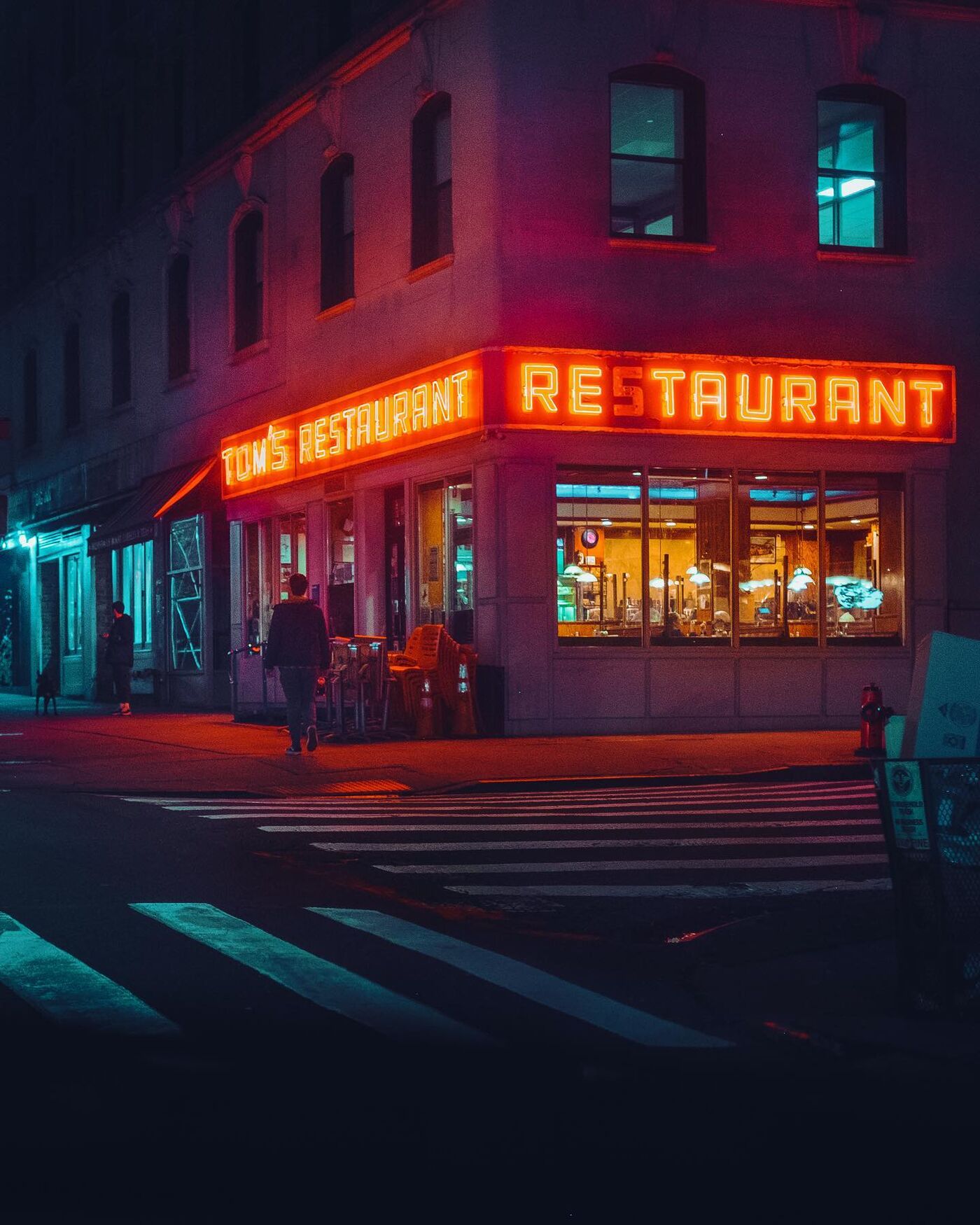
Broadway & 112th Street, Manhattan
The best apple pie in the city
Tom's Restaurant on a Sunday night, under the neon Seinfeld made famous. How a Morningside Heights diner became Monk's Café, and the song it inspired first.
- Where
- Tom's Restaurant, 2880 Broadway at West 112th Street, Morningside Heights, Manhattan, New York
- When
- Sunday night, probably 8 May 2022Another frame from the same corner, taken at 8:49 PM on Sunday 8 May 2022, is in Andrew's photo library. Posted on the morning of Sunday 15 May 2022.
- Posted
- 15 May 2022
- View the post
"The Best Apple Pie in the City…"
Under the buzz of neon, a couple meander through their dessert and their conversation, watched over by the cashier and a painting of a familiar big-haired gentleman in a grey jacket.
Outside, cars tiptoe around the landmine-like potholes, past Sunday night pedestrians lit by the electric glow.
Once a shining beacon of nineties television, time has taken its toll on the sign but hasn't taken it down, a symbol of resilience we could all take a page from, or an episode of Seinfeld.
Tom's Restaurant
Tom's is a diner at 2880 Broadway, on the corner of West 112th Street in Morningside Heights. It takes up the ground floor of Armstrong Hall, a Columbia University building, and Columbia students and staff have been regulars for years.
It has been on this corner since the 1940s, and the Greek American Zoulis family has run it for decades. Sources differ on how it started. Forgotten New York says the Zoulis family founded it. Wikipedia says a man named Tom Glikas did, and the family bought it later and kept the name.
The sign Seinfeld made famous
To Seinfeld fans, this corner is Monk's Café, the show's diner, for its whole run on NBC from 1989 to 1998. Only the outside belonged to Tom's. The show used it for exterior shots, and the scenes inside were filmed on a set in Los Angeles that looked very little like the real room.
Early episodes showed the whole neon sign. Later the TOM'S part was cropped out or dimmed, leaving just the word RESTAURANT. That's the long sign on the right of this photo, on the side facing 112th Street.
The show even had an apple pie plot. In "The Pie" (1994), Jerry's girlfriend turns down a taste of his apple pie after dinner at Monk's, and he can't let it go.
The big-haired gentleman
Inside, Tom's doesn't look like Monk's, but it hasn't ignored the show. Visitors' write-ups mention signed photos of the cast, and several mention Kramer. Food Republic noted a poster of Kramer's portrait in 2011. Patch found a portrait of him at the front booth in 2017. InsideHook put an illustration of Kramer by the counter in 2019, and in 2021 The Blue and White, a Columbia student magazine, described one large portrait of him hanging inside. The descriptions don't quite agree on where it hangs, so it may have moved, or there may be more than one. Either way, the big-haired gentleman watching over that couple is almost certainly Cosmo Kramer.
Kramer had his portrait painted on the show too. In "The Letter" (1992), Jerry's girlfriend Nina, an artist, has Kramer sit for her, and a socialite couple can't take their eyes off the result, one charmed and the other disgusted.
Tom's Diner
Before Seinfeld, there was the song. Suzanne Vega, a graduate of nearby Barnard College, wrote "Tom's Diner" about this place in 1981 or 1982. It opens her 1987 album Solitude Standing, sung with no instruments at all.
In the song, the narrator stops in for a cup of coffee, reads the paper, and watches two women: one who comes in, and one who stands outside in the rain. The idea came from Vega's friend, the photographer Brian Rose, who said he saw his whole life through a pane of glass, a witness to a lot of things who was never really involved in them. She tried to think and write that way, sitting in Tom's.
In 1990 the English producers DNA remixed it, and their version became a much bigger hit than the original, reaching number five in the US and number two in the UK. The German engineer Karlheinz Brandenburg also used Vega's a cappella recording while he was developing MP3 compression, because he knew a warm voice on its own would be nearly impossible to compress well. Audio engineers took to calling her the mother of the MP3.
Sources
- Tom's Restaurant, Wikipedia: the address and corner, the ground floor of Columbia's Armstrong Hall, Columbia students and faculty as regulars, founding by Tom Glikas in the 1940s and later ownership by the Zoulis family, the exterior standing in for Monk's Café, interiors filmed in Los Angeles, the full sign in early episodes and only RESTAURANT later, and Suzanne Vega as a Barnard alumna.
- Kevin Walsh, Tom's Restaurant, Forgotten New York, 19 June 2020: the Zoulis family founding it in the 1940s (this disagrees with Wikipedia), the show's run from 1989 to 1998, and the full sign used in early shoots.
- Tim Moran, "Seinfeld" Fans Still Flock To Iconic Diner Nearly 20 Years Later, Patch, 25 August 2017: the portrait of Kramer at the front booth, the 1940s opening, and the sign facing 112th Street that reads only "Restaurant".
- Jeff Feuerstein, A Visit To The Seinfeld Diner, Food Republic, 9 August 2011 (updated 8 June 2015): pictures of the cast, magazine caricatures and the poster of Kramer's portrait.
- Benjamin Samuel, Review: Checking in on the "Seinfeld" Diner 21 Years Later, InsideHook, 12 July 2019: an illustration of Kramer by the counter, signed posters and caricatures of the cast.
- Willa Neubauer, Peeping Tom's, The Blue and White, 2 March 2021: one large, hanging portrait of Cosmo Kramer inside the diner.
- The Pie, Wikipedia: the 1994 episode in which Audrey passes up Jerry's apple pie after dinner at Monk's.
- The Letter (Seinfeld)), Wikipedia: the 1992 episode, aired on NBC, in which Nina has Kramer pose for a portrait and a socialite couple is captivated by it, one out of endearment and one out of disgust.
- David Sims, Seinfeld: "The Letter"/"The Parking Space"/"The Keys", The A.V. Club, 2 September 2010: the portrait is Nina's painting of Kramer.
- Tom's Diner, Wikipedia: written in 1981 or 1982, the a cappella opener of Solitude Standing (1987), the song's story, the Brian Rose remark behind it, the 1990 DNA remix and its chart peaks, and Karlheinz Brandenburg's use of the song in developing MP3 compression.