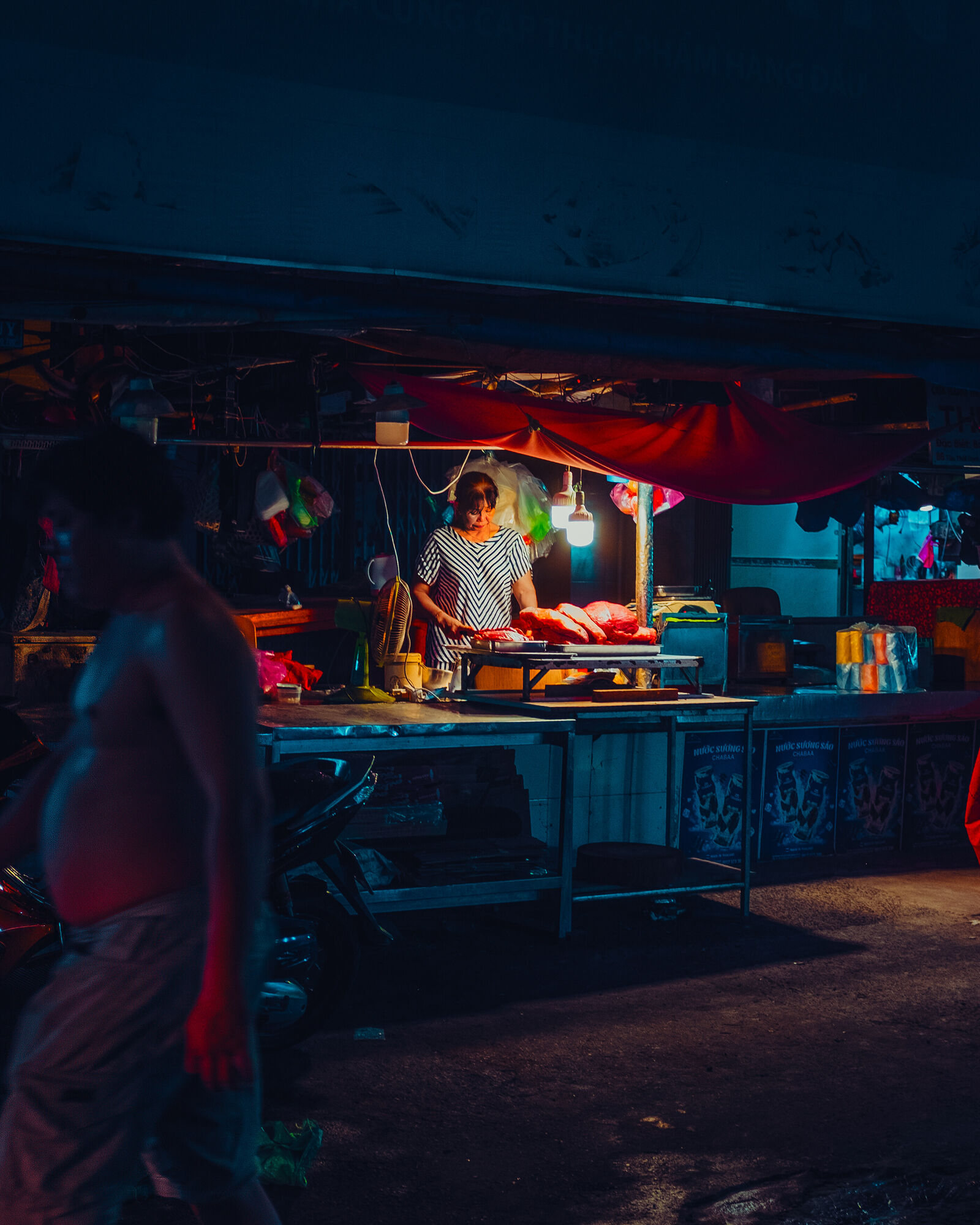
Ho Chi Minh City, 7:42 PM
Thuy's stall
On a Saigon market street at 7:42 PM, the beef under Thuy's bulb is already meant for tomorrow's pho. What the market is, and where that beef ends up.
- Where
- Chợ Tôn Thất Đạm, the street market on Tôn Thất Đạm Street, Bến Nghé ward, District 1, Ho Chi Minh City, VietnamSince 1 July 2025, Bến Nghé is part of the new Sài Gòn ward, and Ho Chi Minh City no longer has districts. Thuy is the name the stall trades under, on its own sign.
- When
- Evening of 21 February 2025, in drizzleThe caption gives 7:42 PM. The photo file logged 7:21 with the camera clock on New York time, so about 7:21 PM in Ho Chi Minh City. Posted 21 February 2025.
- Posted
- 21 February 2025
- View the post
The air is thick. It clings to your skin, leaving a salty sheen on your lips and a heaviness in your lungs. Which explains the shirtless passer-by ambling through the scene, seemingly unfazed by the drizzle or the curious lens aimed in his direction. The damp pavement mirrors the neon from nearby shops, making streaks of red and blue that shimmer at your feet.
In among all that chaos, a row of makeshift market stands lines both sides of the street. Under one of the few that are lit, an overhead bulb casts a warm halo over Thuy's stall, showing large cuts of beef, marbled flanks destined for tomorrow's pho, while the faint smell of raw meat mingles with the savoury notes of broth simmering at the neighbouring stands.
There's a visceral energy here. The taste of the city lingers in the back of your throat, a heady mix of exhaust, spice and the electric promise of street life.
Chợ Tôn Thất Đạm
Tôn Thất Đạm Street runs through Saigon's old centre, close to the river, and for decades its footpaths have held a market of stalls and kiosks. People call it chợ cũ, the old market.
How old it is depends on who you ask. Saigoneer traces the name back to the first Bến Thành market, which traded along the Chợ Vải canal. The canal was filled in in 1887 to make what is now Nguyễn Huệ Boulevard, and once a new Bến Thành market opened on its present site, which Wikipedia dates to 1914, the traders moved to Tôn Thất Đạm. In that telling, the old market was known for imported goods, from American perfume to European cosmetics. The newspaper Sài Gòn Giải Phóng gives a shorter history: an informal market that sprang up in Nguyễn Thái Bình ward in 1967, moved to Hàm Nghi Street, and then settled on Tôn Thất Đạm. A 2022 Saigoneer piece also dates the kiosk market itself to the late 1960s.
The city has been trying to move it on for a long time. Relocation was first discussed in 2003. A closure was approved in 2013, but the documents guiding it were classified, and as of July 2023 the market still hadn't closed. In 2022 it had 201 registered vendors. It was still trading on the night of this photo.
What pho is
Pho is a soup of rice noodles in broth, with herbs and meat, usually beef or chicken. It began in northern Vietnam, with cooks from Nam Định usually credited, though sources place its start anywhere from the late 1800s to the first years of the 20th century. When the country was divided in 1954, many northerners moved south and brought pho with them. The southern version, the one you'll find in Saigon, has a sweeter, darker broth, and comes with bean sprouts, herbs such as Thai basil, hoisin and sriracha.
The broth is the slow part. Beef bones are simmered for hours, up to 12 according to National Geographic, with charred onion and ginger and spices such as star anise and cinnamon. In Hà Nội people mostly eat pho for breakfast, though it's sold all day.
The beef
A pho menu names its beef by the cut. Tái is rare steak, sliced thin and added just before serving, so the hot broth cooks it lightly. Chín is brisket or another tough cut that has been cooked in the broth. Nạm is flank, rough and chewy, and a different thing from Western flank steak. Gầu is brisket with a thick layer of fat. Gân is tendon, soft and gelatinous.
Sources
- The End of Ton That Dam's Chợ Cũ, Saigoneer, 22 February 2017: the name traced to the first Bến Thành market and the Chợ Vải canal, filled in in 1887; the move to Tôn Thất Đạm after the new Bến Thành opened; imported goods.
- Thu Hường, Chợ Tôn Thất Đạm vẫn đang chờ giải tỏa, Sài Gòn Giải Phóng, 10 October 2015: began as an informal market in Nguyễn Thái Bình ward in 1967, moved via Hàm Nghi Street to Tôn Thất Đạm in Bến Nghé ward; also called chợ cũ.
- Facing Another Removal Plan, Will Chợ Cũ Tôn Thất Đạm Survive 2022?, Saigoneer, 11 May 2022: the kiosk market from the late 1960s, relocation talk since 2003, 201 registered vendors.
- Cẩm Nương and Tiến Long, Văn bản hướng dẫn đóng dấu mật, chợ Tôn Thất Đạm 10 năm chưa đóng cửa được, Tuổi Trẻ, 12 July 2023: closure approved in 2013 and not carried out because the guiding documents were classified.
- Bến Thành Market, Wikipedia: the new market built from 1912 to 1914.
- Phở, Wikipedia: what pho is, the broth (beef bones, charred onion and ginger, star anise, cinnamon), an origin between 1900 and 1907 with Nam Định cooks.
- Ryley Graham, What pho can teach us about the history of Vietnam, National Geographic, 23 April 2025: an origin in the late 1800s in Nam Định; broth simmered up to 12 hours; breakfast in Hà Nội; pho moving south after 1954 and the southern garnishes.
- Phuc Trinh, Pho: the story of Vietnam's national treasure, VnExpress International, 30 January 2025: an origin in the early 20th century, carried to Hà Nội by peddlers from Nam Định.
- Andrea Nguyen, A pho pronunciation guide and menu decoder, Viet World Kitchen, 12 February 2025: tái, chín, nạm, gầu and gân.
- Toàn văn Nghị quyết số 1685/NQ-UBTVQH15 sắp xếp các ĐVHC cấp xã của Thành phố Hồ Chí Minh năm 2025, Government of Vietnam policy portal, 20 June 2025: clause 1 forms Sài Gòn ward from all of Bến Nghé and parts of Đa Kao and Nguyễn Thái Bình; new wards operating from 1 July 2025.
- Angela Ho, A Post-Merger Guide To Ho Chi Minh City: Understanding The City, Vietcetera, 27 July 2025: the district system ended on 1 July 2025, and old District 1 is now four wards, Sài Gòn among them.